European-made GDPR compliant people counting sensors
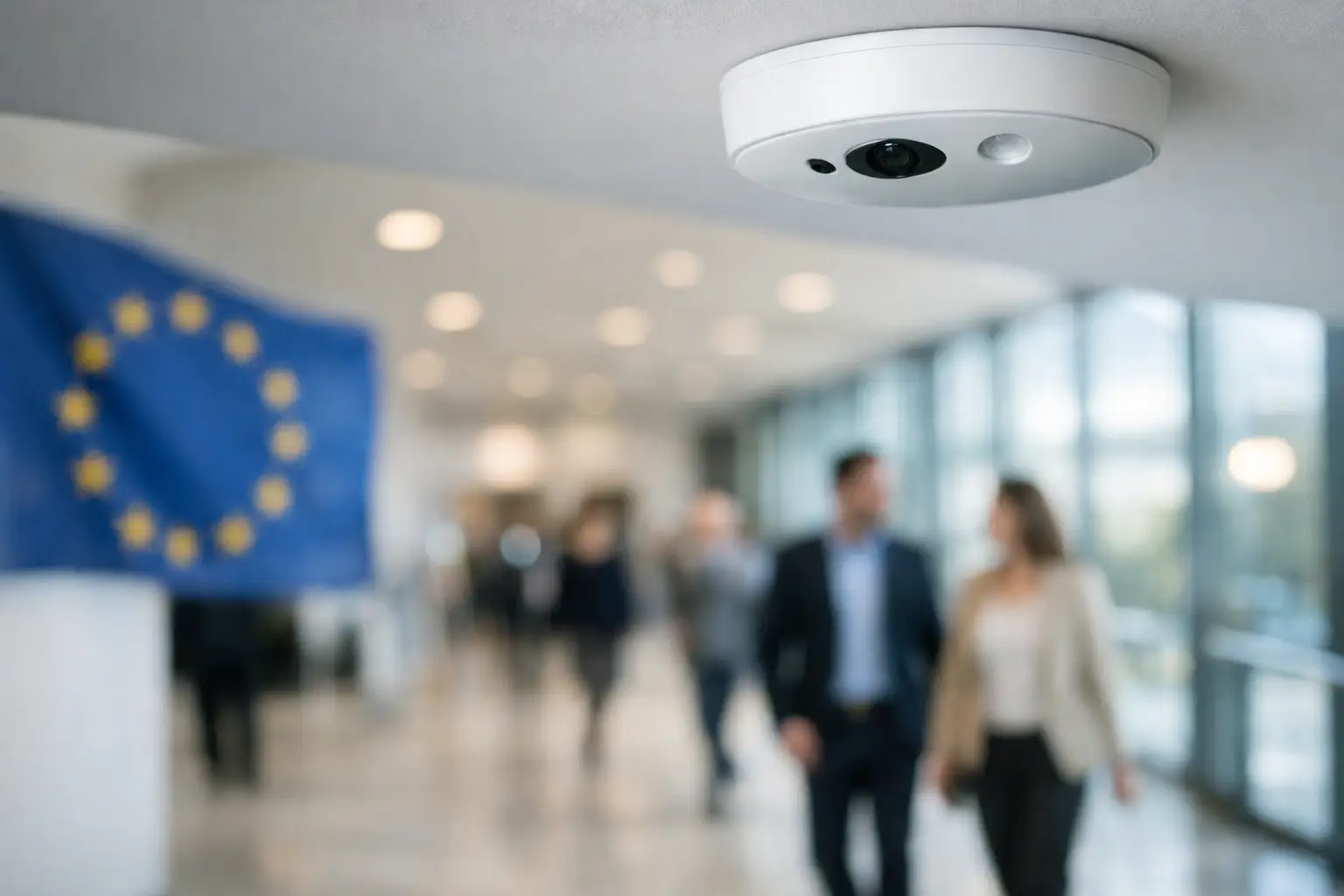
A hotel chain can tolerate many operational inefficiencies for a while. A privacy mistake tied to customer tracking is less forgiving. That is why european made GDPR compliant people counting sensors have moved from a technical procurement detail to a board-level question in retail, property, public venues, and smart building projects.
For Nordic decision-makers, the issue is not only whether a sensor counts accurately. It is whether the full solution stands up to scrutiny from legal, IT, procurement, and operations at the same time. If the device architecture is unclear, if personal data boundaries are vague, or if data hosting and vendor accountability sit outside Europe without clear safeguards, the risk profile changes quickly.
Why european made GDPR compliant people counting sensors matter
People counting used to be discussed mainly in terms of footfall. Today the conversation is broader. Occupancy analytics inform staffing, lease planning, cleaning schedules, energy optimization, queue management, safety compliance, and portfolio decisions. That makes sensor data commercially useful, but it also raises the standard for governance.
A European-made solution often matters for three practical reasons. First, supply chain and product accountability are easier to assess when manufacturing, development, and support sit closer to the operating market. Second, documentation around data handling, product specifications, and compliance tends to align better with European procurement and regulatory expectations. Third, the vendor is more likely to understand the operational realities of GDPR, not just treat it as a legal appendix.
That does not mean every European product is automatically compliant, or that every non-European product is unsuitable. The point is narrower and more useful: for organizations that want lower compliance friction, clearer auditability, and fewer cross-border ambiguities, European origin can be a meaningful strategic advantage.
What GDPR compliant people counting sensors actually mean
This is where many projects become imprecise. A vendor may say a system is privacy friendly when what they really mean is that the device can be configured in a privacy friendly way. Those are not the same thing.
A genuinely GDPR-conscious people counting setup usually starts with data minimization. If the business need is to count entries, exits, dwell time, or occupancy levels, then the system should not collect more information than necessary to achieve that purpose. In practice, that often means edge processing, anonymized event data, and architecture designed to avoid storing identifiable imagery.
For executive buyers, the key question is not whether the technology is advanced. It is whether the processing logic is proportionate to the stated business purpose. If a simple occupancy use case is supported by a system that captures or retains video in a way that introduces unnecessary personal data exposure, the compliance burden grows immediately.
This is also why sensor type matters. Some devices rely on overhead stereoscopic vision, some use thermal or infrared methods, and some combine multiple inputs for better accuracy. Each approach has implications for privacy, counting precision, environmental performance, and deployment cost. There is no universal best option. There is only a better fit for the context.
The strategic trade-off: accuracy, privacy, and operational fit
Senior buyers rarely need the highest technical specification in isolation. They need dependable business outcomes. In people counting, three factors tend to compete.
The first is accuracy. If the output will feed lease negotiations, staffing models, or capital allocation decisions, the data needs to be credible. Entrance counting can be relatively straightforward in controlled conditions. Multi-directional traffic, group movement, strollers, trolleys, and unusual layouts make the problem harder.
The second is privacy exposure. The more granular the captured data, the more questions follow. Can individuals be identified, directly or indirectly? Is imagery stored? Who can access it? Where is processing performed? How long is any data retained? If the answer set is complex, internal approval cycles usually become slower.
The third is operational fit. A sensor may perform well in a lab but poorly in older real estate, mixed-use buildings, or harsh lighting conditions. Ceiling height, mounting angles, network constraints, and integration requirements all matter. In many cases, the best procurement decision is not the most sophisticated sensor. It is the one that produces decision-grade data with the least governance and maintenance burden.
European-made GDPR compliant people counting sensors in procurement
For procurement teams and leadership groups, the evaluation should go beyond marketing claims. A strong review process looks at the whole operating model.
Start with purpose definition. Is the organization measuring footfall at store entrances, real-time occupancy in offices, usage patterns in public buildings, or conversion between visits and transactions? The narrower the use case, the easier it is to assess whether the proposed data processing is proportionate.
Then test the compliance architecture. Ask how the device counts, what raw data is captured, whether any images are stored, where computation happens, and what exactly leaves the sensor. Request clear statements on controller and processor roles, retention logic, and support for data protection impact assessments where relevant.
After that, review deployment reality. Many sensor projects fail quietly because installation assumptions were optimistic. Counting accuracy may be affected by architectural constraints, visitor flow patterns, or network design. A capable vendor should be able to discuss where accuracy deteriorates and what mitigation is realistic.
Finally, examine resilience. If the solution becomes embedded in occupancy planning, facility management, or investor reporting, business dependency increases. Decision-makers should know how firmware updates are governed, how cybersecurity is handled, what support capability exists in Europe, and whether documentation is strong enough to survive personnel changes on both sides.
Where these sensors create business value
In retail, reliable people counting informs labor planning, campaign evaluation, and store network decisions. A chain does not need abstract traffic numbers. It needs comparable data between locations and enough confidence to make staffing and lease decisions without debating the measurement method every quarter.
In offices and mixed-use properties, occupancy data can support space optimization and energy efficiency. Yet this is also where privacy sensitivity can rise. If the perception among staff or tenants is that monitoring has moved from space utilization to individual observation, trust declines fast. The right system design avoids that tension by keeping the focus on anonymous spatial patterns rather than identifiable behavior.
In public venues, transport environments, and municipal use cases, people counting can support safety, service planning, and operational responsiveness. Here, procurement discipline matters even more because public accountability is higher. A system that is accurate but poorly documented can become a governance problem regardless of technical performance.
What Nordic buyers should look for
Nordic organizations are typically well served by a cautious, documentation-led approach. That does not mean slowing projects unnecessarily. It means front-loading the right questions so deployment moves faster later.
Look for vendors that can explain the product in plain language, not only in technical terms. If a provider cannot state clearly what data is collected and what is not, that is usually a warning sign. Clarity is especially valuable when legal, IT, and business teams need to align quickly.
Also look for evidence of maturity rather than overclaiming. A credible supplier will acknowledge edge cases, installation dependencies, and the limits of accuracy in challenging environments. For senior decision-makers, that honesty is more useful than inflated performance promises.
For organizations operating in Finland and the wider Nordic market, regional fit also matters. Documentation quality, support responsiveness, and alignment with European compliance expectations can reduce both project friction and long-tail risk. In that sense, the attraction of European-made solutions is not ideological. It is operational.
A better buying question
The most useful question is not, Which people counting sensor has the most features? It is, Which solution gives us reliable occupancy intelligence with the lowest unnecessary privacy, governance, and implementation risk?
That shift in framing improves procurement quality immediately. It moves the discussion from gadget evaluation to strategic fit. For leadership teams, that is the right level of analysis. A sensor is a small device, but the consequences of choosing the wrong architecture can extend into legal review, stakeholder trust, portfolio decisions, and future data strategy.
When the objective is sound operational insight without avoidable compliance complexity, european made GDPR compliant people counting sensors deserve serious consideration. Not because the label alone guarantees quality, but because in the right deployment they align commercial usefulness with a more disciplined risk posture. That is usually where the strongest long-term decisions are made.